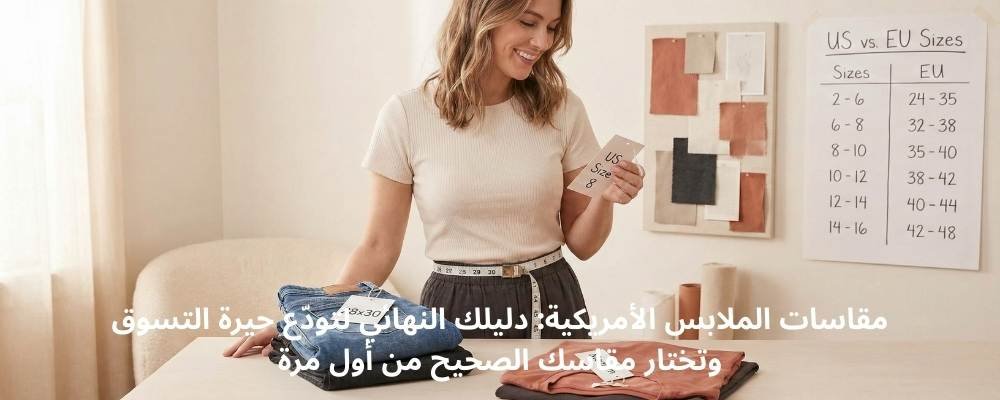
US Clothing Sizes: Your Ultimate Guide to Saying Goodbye to Shopping Confusion
Let me guess, you found that perfect piece online. The dress you’ve been dreaming of, or perhaps the pair of jeans that look like they'll change your life. You enthusiastically add it to your cart, then stop dead. That familiar feeling of anxiety creeps in when you see the size options: 6, 8, M, 10P. What do all these numbers and letters mean? I know this feeling well; it’s the frustration that comes with shopping US brands. You feel like you need a degree in cryptography just to buy a shirt. The bitter truth is that the world of US sizing is a bit chaotic, and it’s absolutely not your fault. Unlike the more standardized European systems, there is no strict standard that all US brands follow. Every brand makes its own rules, meaning a "Medium" in one store might be a "Large" in another. This leads us to the question everyone asks: How do I know my US clothing size when everything seems random?
Why are US sizes so confusing?
A big part of the problem lies in a phenomenon known as "Vanity Sizing," where brands manipulate size numbers downwards to make us feel smaller. It’s purely a marketing tactic, but it leaves us utterly confused. That’s why relying on just one number is a recipe for frustration. Finding a US women's clothing size chart that is accurate and reliable can be a difficult task in itself, as every chart differs from the next. This is especially true when it comes to specific products, where understanding US jeans sizes becomes a unique challenge requiring knowledge of waist and inseam measurements.
That’s not all; the system itself is inherently complex. There are "Petite" sizes for shorter stature, "Plus" for larger sizes, and "Juniors" for younger women, and each category has its own logic. But don't worry, I'm not here to add to your confusion, but to be your friend and guide in this confusing world. I've designed this comprehensive guide to give you the tools and knowledge you need to feel confident every time you hit that "Add to Cart" button.
This guide is your new shopping friend
I’ll be with you step-by-step, starting with the basics: how to take your body measurements correctly using a tape measure. After that, we’ll dive into the details. I’ll provide you with a clear and simplified US women's clothing size chart as a base to start from. We won't stop there; we’ll cover everything from straightforward men's sizes to understanding US jeans sizes, which cause headaches for many. The ultimate goal is for you to be able to answer the question "How do I know my US size" with confidence and shop with joy and peace of mind, just as it should be.
Section 1: Measurement Basics and Understanding the System
Alright, let’s get to work. First things first, forget the number you think is your size. That number means nothing right now. Your new secret weapon is a flexible measuring tape, the kind tailors use. If you don't have one, it's the best investment you can make for this shopping journey. It is non-negotiable.
How to take your measurements like a pro
Take a deep breath, stand up straight, and let's begin. We are looking for three key measurements for the upper body and two for pants. Wrap the tape around your body parts but don't pull it too tight; it should be comfortable enough to slide one finger underneath.
- Bust: Measure around the fullest part of your chest, keeping the tape parallel to the floor.
- Waist: Find your natural waist. Bend to one side and you'll find a natural crease – that’s the spot. It is usually the narrowest part of your torso.
- Hips: Stand with your feet together and measure around the fullest part of your hips and bottom.
- Inseam: This measurement is for pants. Measure from the top of the inner thigh down to where you want the pants to end. It is easier to measure a pair of pants that already fit you well; lay them flat and measure from the crotch seam to the bottom hem.
Decoding Numbers and Letters
Now that you have your numbers, let’s talk language. In America, everything is measured in Inches. For international shoppers, remember this simple equation: 1 inch = 2.54 centimeters. Write down your measurements in both inches and centimeters so you are ready for any size chart.
You will see numerical sizes (like 2, 4, 6) and alpha sizes (XS, S, M, L). Generally, numerical sizes are more specific and are often used for more tailored women's clothing like dresses and formal trousers. Alpha sizes are more common in casual wear like t-shirts and knitwear. But remember, there is no universal correspondence between them. A size 8 in one brand might be a "Medium", and in another brand, it might be a "Small".
This leads us to the Golden Rule, the most important advice I will give you: The brand's specific size guide is the absolute truth. Ignore the number on your old clothes. Take your new measurements and compare them directly to the size chart on the website of the product you want to buy. This is the only step that guarantees accuracy.
Section 2: Detailed Guide to US Women's Clothing Sizes
I know the women's section is where the real chaos lies. It's not just numbers; it's a whole world of categories designed for different body types and heights. Let's decode this mystery together.
Misses Sizes: The Standard
These are the sizes most women think of when shopping. They use even numbers, usually starting from 00 or 0 and going up to about 16 or 18. These sizes are designed for a woman of average height (usually between 163 cm and 170 cm) with balanced proportions. Any US women's clothing size chart you find online will usually start with this category as the baseline.
Plus Sizes: Celebrating Curves
Plus sizes aren't just larger versions of standard sizes. The design here is different to better fit fuller bodies. This category usually starts from size 14W and goes up (16W, 18W, etc.). That "W" is very important; it stands for "Women's" and indicates that the cut is designed with extra room in the bust, waist, and hips. Ignoring this "W" is a common mistake that leads to ill-fitting clothes.
Petite Sizes: Not Just for Skinny Women
This is where many get it wrong. "Petite" has nothing to do with weight; it's about height. These sizes are designed for women who are under 5 feet 4 inches tall (about 162 cm). They are marked with a "P" after the number (like 8P). The main difference is that everything is proportionately shortened: shorter torso, shorter sleeves, and shorter pant length. If you always find sleeves are too long for you, you might be in the "Petite" category even if you wear a size 12.
Junior Sizes: A Youthful Cut
This category is particularly confusing. "Juniors" sizes use odd numbers (1, 3, 5, 7, etc.) and are originally designed for teenagers. The cut is generally narrower and straighter, with less room in the bust and hip areas compared to "Misses" sizes. If you are an adult woman with a slim, straight frame, you might find these sizes fit you. But never assume a size 5 "Juniors" equals a size 4 or 6 "Misses"; it's a different world entirely.
Jeans Guide: Decoding Waist and Length
Jeans have their own system. Understanding US jeans sizes starts with knowing that most brands use the waist measurement in inches as the size number (like 26, 27, 28, 29). This number is your actual waist measurement. Sometimes, you will see a second number for the Inseam (length), like "28x30". However, many women's jeans brands offer only one standard length, which makes things a bit more difficult.
Section 3: Simplified Guide to US Men's Clothing Sizes
Guys, you have it much easier. Seriously. Your sizing system is much more logical and straightforward, relying heavily on actual measurements. There are still some nuances, but they don't compare to the complexities women face.
Upper Body Sizes (Shirts, Jackets)
For casual clothes like t-shirts, sweaters, and jackets, the system relies on classic alpha sizes: S (Small), M (Medium), L (Large), XL (Extra Large), and so on. Each size corresponds to a chest circumference range in inches. For example, a "Medium" is usually suitable for a chest circumference between 38 and 40 inches. It's very simple: measure your chest, and check the brand's size chart.
Dress Shirts: The Art of Precision
Here it gets more specific, and that's a good thing. Dress shirts are measured by two numbers, like "15.5 34/35". The first number (15.5) is your neck circumference measurement in inches. The second number (34/35) is the sleeve length, measured from the center of the back of your neck, over your shoulder, down to your wrist. This system ensures a perfect fit around the neck (so it doesn't choke you or hang too loose) and the perfect sleeve length.
Pants and Trousers: The Logical W x L System
This is the gold standard of simplicity. Most men's pants, including jeans, are measured by two numbers separated by an "x", like 34x32. The first number (W) is the waist circumference in inches. The second number (L) is the inseam length in inches. This system is great because it allows you to choose your exact size. Understanding US men's jeans sizes relies entirely on knowing these two numbers.
Big & Tall Sizes
This category serves men who need either a wider cut or extra length. "Big" sizes are known by numbers like 2XL, 3XL, designed with a roomier cut in the body. "Tall" sizes, often marked with a "T" (like LT for Large Tall), are designed for men taller than 6 feet 2 inches (about 188 cm). They have longer lengths in the torso and sleeves to ensure the shirt doesn't look too short.
Section 4: Children and Baby Clothing Size Guide
Buying clothes for kids is like aiming at a moving target. They grow so fast, and their sizing can be equally confusing. The basic rule here: Age is just a suggestion. Height and weight are your true guides.
Baby and Newborn Sizes
Sizes here start with NB (Newborn), then move to categories based on age in months: 0-3M, 3-6M, 6-9M, 12M. But a 4-month-old baby might be tall and need a 6-9M size. That's why most brands put weight and height ranges next to each size. Always rely on these numbers, not just your child's age.
Toddler Sizes
After size 24M, you move to the "Toddler" category, indicated by a "T" after the number: 2T, 3T, 4T, 5T. These sizes are designed for little ones who have started walking, and often have a slightly wider cut in the diaper area. Again, check the height and weight charts.
Older Kids Sizes (Kids/Youth)
Once past 5T, you move to "Kids" sizes starting with numbers 4, 5, 6, and so on. At this stage, sizes often split into "Girls" and "Boys", with slight differences in cut. As they approach early teen years, you'll start seeing alpha sizes appear again: S, M, L, XL, but in the "Youth" or "Kids" category. Practical tip? When in doubt, buy a size up. They can always grow into it, but you can't make a small piece bigger.
Section 5: Beyond the Numbers: Vanity Sizing and Lack of Standardization
Now that we've covered the technical details, it's time for some straight talk. The reason you constantly ask "How do I know my US size" isn't because you don't understand, but because the system itself is broken. It is designed to be confusing.
The Bitter Truth About Vanity Sizing
This is the practice, followed by most brands, where size numbers are artificially downsized over the years. A size 8 today might have the same dimensions as a size 12 or 14 from the 70s. Why do they do this? It is a purely psychological tactic. The idea is that if you think you fit into a smaller size, you will feel good about yourself and the brand, and are more likely to buy. It is a marketing trick, but it leaves us consumers in a state of absolute chaos.
A History of Organized Chaos
In the mid-20th century, there was an attempt by the US government to standardize clothing sizes based on a large-scale study of American women. But these standards were voluntary, and by the 80s, they were abandoned completely. This void led to what we have today: a free market for sizing where every brand can do whatever it wants. This is why you might be a "Medium" in Nike, a "Large" in J.Crew, and a "Small" in another brand. There is no overseer of the system.
And that is why the real question "How do I know my US size" has no single simple answer. The answer changes with every website you visit and every store you enter. It is frustrating and increases online return rates enormously, hurting the environment and our patience. Honestly, it can negatively affect our body image, making us feel there is something wrong with us, while the problem lies in the label. Any US women's clothing size chart you find is just a starting point, not a fixed law.
In comparison, European systems tend to be more logical, as they are often directly linked to body measurements in centimeters. It is a less emotional and more scientific system. But there is a glimmer of hope on the horizon. With the emergence of technologies like 3D body scanning and AI, some companies have started offering personalized size recommendations that could eliminate guesswork in the future. But until that day, the measuring tape and the brand's size chart are your best friends.
Article Summary
The American clothing sizing system is a common source of confusion for shoppers due to the lack of standardization and the phenomenon of "Vanity Sizing," where brands downsize numbers as a marketing ploy. This guide offers a practical solution by emphasizing the importance of taking accurate body measurements (bust, waist, hips) using a flexible tape measure.
The guide explains the differences between various categories of women's clothing such as Misses, Plus, Petite, and Juniors. It also simplifies the straightforward men's sizes based on neck, chest, and waist measurements. For children's clothing, the guide emphasizes relying on height and weight rather than age. The most important strategy recommended by the guide is to ignore usual numbers and always refer to the specific size chart of each brand to ensure the correct choice and avoid shopping confusion.
Frequently Asked Questions (FAQ)
1. Why does my size vary so much from one US brand to another?
This large variation in sizes between American brands is primarily due to two interconnected reasons. The first is a phenomenon known as "Vanity Sizing." This is a deliberate marketing practice where companies lower numbers on size labels over time. For example, dimensions of a garment that was classified as a size 12 in the 70s might be sold today as a size 8. The goal is to make consumers feel good about their size, encouraging them to buy. It's a purely psychological strategy that has created chaos in the market.
The second reason is the absence of a unified and mandatory government standard for sizing in the United States. After abandoning initial attempts to standardize sizes in the mid-20th century, every brand became free to set its own standards. This means a "Medium" size in one store might equal a "Large" or "Small" in another, as there is no regulatory body enforcing consistency. Consequently, there is no single simple answer to knowing your size, and the answer changes with every website you visit and every store you enter.
2. What is the exact difference between size 10 and size 10P in women's clothing?
The fundamental difference between size 10 and size 10P lies in the length and proportion of the garment, not in the weight or width of the body. The letter "P" stands for "Petite," and this category is specifically designed for women who are under 5 feet 4 inches tall (about 162 cm). The common belief that "Petite" sizes are only for skinny women is a complete misconception; the size relates to stature, not weight. You can find petite sizes up to 12P or higher.
When you choose size 10P, you get a piece whose dimensions have been proportionately adjusted to fit a shorter stature. This means the torso length in a dress or shirt will be shorter, sleeve length will be shorter, and the inseam in pants will be shorter compared to a regular size 10. This adjustment ensures that the waistline, hem, and sleeves fall in the correct place on the body, providing a much better fit than simply shortening a regular-sized piece at a tailor.
3. What does size "34x32" mean on a men's pants label?
This double number system, like "34x32", represents the standard and most accurate way to determine sizes for men's trousers and pants, including jeans. It is a logical system relying entirely on actual body measurements in inches, making it easy to understand and allowing for precise selection. The first number, in this case "34", always represents the Waist measurement in inches. To know this number, you must measure your natural waist circumference where you usually wear your pants.
The second number, which is "32" in this example, represents the Inseam measurement in inches. The inseam is measured from the top of the inner thigh down to the point where you want the bottom hem of the pants to reach. This dual system gives men the ability to choose a size that fits their width and height independently, ensuring a perfect fit without the need for major alterations, which is one reason why men's clothes shopping is simpler and more straightforward compared to women's.
4. Can I rely on my child's age when buying clothes from US brands?
No, you should not rely on a child's age as the sole factor when choosing their clothing sizes. The age mentioned on labels, such as "3-6M" (for infants) or "4T" (for toddlers), is merely a suggestion or a general average. Children grow at very different rates; a 6-month-old baby might be taller or heavier than average and need a size meant for 9-12 months, and vice versa. Relying solely on age is a common reason for buying ill-fitting clothes.
The true and most accurate guide is referring to the size charts provided by the brand itself. Most professional brands attach specific ranges for height (in cm or inches) and weight (in kg or lbs) for each size. Before buying, you should measure your child's height and weight and compare these figures to the chart to choose the correct size. As an extra practical tip, when hesitating between two sizes, it is always wise to choose the larger size, as the child can grow into it, whereas a small piece cannot be adjusted.
5. What is the difference between "Juniors" and "Misses" size categories?
The "Juniors" and "Misses" categories target two different age groups and body types, and confusing them often leads to ill-fitting clothes. "Junior Sizes" are known to use odd numbers (1, 3, 5, 7, etc.) and are originally designed for teenagers and young women. The cut of these clothes is generally narrower and straighter, with less room in the bust and hip areas and a slightly higher waist, to fit bodies that haven't fully developed curves yet.
In contrast, "Misses Sizes" use even numbers (0, 2, 4, 6, etc.) and are the standard for adult women's clothing. These sizes are designed to fit an adult woman of average height and more balanced proportions, taking into account sufficient room for the curves of the bust, waist, and hips. It is a mistake to assume that a size 5 in the "Juniors" category equals a size 4 or 6 in the "Misses" category; they are completely different systems relying on radically different cuts and dimensions.
6. Are Plus Sizes just enlarged versions of regular sizes?
This is a common misconception. Plus sizes are not just copies scaled up equally from regular sizes (Misses Sizes). Instead, it is a category designed with completely different proportions and cuts to better fit and celebrate fuller bodies and curves. This category usually starts from size 14W and up, and the letter "W" which stands for "Women's" is a crucial indicator. This letter indicates that the piece was not just designed to be wider, but engineered to provide extra room in specific areas like the bust, waist, and hips.
Fuller bodies require a design that considers a different distribution of mass, which may include adjustments in the armhole shape, shoulder width, and tummy area design. Ignoring the letter "W" and buying a large regular size (like 18 Misses instead of 18W) can lead to clothes that are tight in some areas and oddly loose in others. Therefore, when shopping in the plus-size category, it is essential to look for sizes marked with "W" to ensure the best possible fit.
Sources & Further Reading
- Nike.com: Men's Clothing Size Chart. (https://www.nike.com/help/a/size-charts)
- Vox: The absurdity of women's clothing sizes, in one chart. (https://www.vox.com/advice)
Final Summary
This article provides a comprehensive guide to solving the confusing issue of American clothing sizes, which stems from a lack of standardization and the phenomenon of "Vanity Sizing." The guide emphasizes that the solution lies in abandoning usual numbers and starting to take accurate body measurements (bust, waist, hips) in inches. The article covers in detail the different categories of women's clothing (Misses, Plus, Petite, Juniors), simplifies the logical men's sizing system, and offers practical guidelines for choosing children's sizes based on height and weight rather than age. The golden rule focused on in the article is the necessity of always referring to the specific size chart of each brand to ensure the correct choice and avoid shopping confusion.
Tags
How to convert US clothing sizes to European, Detailed US women's jeans size chart, Explanation of Petite and Plus sizes in US clothing, Best way to know American kids clothing size